
If this kind of work is useful to you, I would ask you to consider supporting it. Everything I do at Scholastic Answers depends on the support of readers. The most helpful thing you can do is to become a paid subscriber on Substack or a supporter on Patreon for as little as $5 a month, which allows me to keep writing. If you have already done so, thank you!
Or, at least enter your email to get my articles in your inbox and give this article a like:
Introduction
Often, Catholic theologians will use arguments derived from one of the spiritual senses of Scripture in order to demonstrate a Catholic dogma. As an example, we can look at the commonly cited text of Ezekiel that has been used since the patristic era in order to argue in favor of Our Lady’s perpetual virginity: “This gate shall be shut, it shall not be opened, and no man shall pass through it: because the Lord the God of Israel hath entered in by it” (Ezek. 44:2). The “gate” is taken for the Blessed Virgin, and the “entering in” of the Lord God is the conception of Our Lord. Therefore, the statement that “no man shall pass through it” is taken as an assertion of her perpetual virginity. St. Thomas himself makes this text the sed contra of his article on whether the Mother of God remained a virgin after the birth of Christ.1
Another famous example is an argument in favor of Our Lady’s Assumption, which quotes the Psalm: “Arise, O Lord, into thy resting place: thou and the ark, which thou hast sanctified” (Ps. 131:8). The ark is identified with Our Lady and the Lord is taken for Christ. Therefore, the arising into the resting place is taken for Our Lord taking Our Lady into his resting place, which is identified with her Assumption into heaven. Ven. Pius XII records this very argument in the constitution defining the Assumption.2
A third example is the sacrifice of Melchisedech. Genesis records that Melchisedech, king of Salem and priest of the most high God, “bringing forth bread and wine,” blessed Abraham (Gen. 14:18). The Council of Trent teaches that Our Lord, “declaring himself constituted a priest forever according to the order of Melchisedech,” offered his body and blood to the Father under the species of bread and wine at the Last Supper, so that the sacrifice of the Mass was prefigured by the offering of Melchisedech.3 The bread and wine of Genesis are taken as a figure of the Eucharistic sacrifice.
I can give countless examples of this move taken by scholastic theologians, dogmatic theologians, magisterial texts, and exegetes.
In response to these citations, an interesting objection has taken shape among Protestant apologists in response to Roman Catholicism. Rather than dealing individually with each use of the spiritual sense, they give a certain universal principle in the words of St. Augustine against the practice of demonstrating dogmas in this mode (which is quoted by St. Thomas):
The multiplicity of these senses does not produce equivocation or any other kind of multiplicity, seeing that these senses are not multiplied because one word signifies several things, but because the things signified by the words can be themselves types of other things. Thus in Holy Writ no confusion results, for all the senses are founded on one—the literal—from which alone can any argument be drawn, and not from those intended in allegory, as Augustine says (Epis. 48). Nevertheless, nothing of Holy Scripture perishes on account of this, since nothing necessary to faith is contained under the spiritual sense which is not elsewhere put forward by the Scripture in its literal sense. (Summa theologiae I, q. 1, a. 10, ad 1)
The letter of St. Augustine to which St. Thomas refers is his letter to Vincent the Rogatist (Epistle 48 in the old numbering, Epistle 93 in the numbering now in use). The Donatists had claimed that the Church was prophetically said to one day only exist in Africa on the basis of the words of the Canticle, “where thou feedest, where thou liest in the midday,” taking “midday” for the hot southern lands they inhabited. St. Augustine replies: “But who would not most impudently attempt to interpret in his own favor something set down in allegory, unless he also has manifest testimonies by whose light the obscure things may be illuminated?”
The difficulty presented here is obvious. If it is true that the literal sense is that “from which alone any argument can be drawn,” then countless arguments we give for dogmas from the spiritual senses of Scripture are null.
How do Catholic theologians respond? While some may expect them to deny this principle (chalking up the statements of Ss. Augustine and Thomas to a minor error), such is not the case. Catholic theologians universally accept this principle. In my research, I have not found a single one who rejects it. But I have also not found a single one who accepts it without qualification, i.e., that the axiom is true of the spiritual sense considered in itself and known from the text alone, and that it ceases to apply as soon as the spiritual sense has been made certain by some other means.
In order to answer this question in greater detail and vindicate the axiom in its traditional sense, we need to consider in greater depth the nature of the spiritual senses and of dogmatic argumentation.
What Are the Spiritual Senses?
In order to resolve this question properly, we must first determine what is meant by the “spiritual senses.” This phrase, “spiritual sense,” is composed of a generic term, “sense,” and a specifying term, “spiritual,” which distinguishes it from the “literal sense.”
On the notion of the ‘sense’. A “sense” is a meaning, that is, what a sign signifies. To see what this involves, we can follow the doctrine of St. Thomas in the opening lectures of his commentary on Aristotle’s On Interpretation. Words are signs. What they signify first and immediately are what Aristotle calls the “passions of the soul,” which St. Thomas explains to be the conceptions of the intellect, that is, what we ordinarily call concepts or ideas. These conceptions are likenesses of things. Therefore words also signify things, but mediately: they signify the conceptions of the intellect immediately, and through these conceptions they signify the things of which the conceptions are likenesses. The concept is something that formally resides in the soul. Yet, by a manner of speaking, “sense” is frequently taken for something that formally resides in the signs that are produced by man in order to communicate the concepts that reside in the soul, whether written or oral (i.e., written or oral words). The “sense” is the relation or referentiality that these signs have towards those conceptions of the intellect insofar as they are artificially formed in order to signify these concepts.
It is to be noted (following St. Thomas) that these signs do not directly or immediately signify things in reality, but directly and immediately signify the ideas or concepts of these things as they exist in the understanding. Our words signify our ideas or concepts, which themselves are intentional beings that have the same nature as external things, but with a distinct mode of existence (real esse vs. intentional esse). Therefore, the “sense” of a word can either be taken as the property of the word to conventionally refer to such-and-such a nature (immediately as it exists in the intellect and mediately as it exists in reality), or it can be taken for the very nature itself as it exists in the intellect.
On the literal sense. Since the specifying term of the phrase “spiritual sense” is the term “spiritual,” we can determine the notion from the opposite which adequately distinguishes the genus, i.e., the term “literal.” This is especially important due to a common misunderstanding about the term “literal” in relation to Scripture. The “literal” is that which is related to the “letter,” which is why literal exegesis is sometimes referred to as exegesis ad litteram, i.e., “to the letter.” The “literal,” in contemporary English, is often taken for the exegesis of a certain passage that excludes certain literary devices, e.g., a metaphor is “non-literal” insofar as it speaks with a certain literary device which takes the word outside of its ordinary signification. For example, if we were to refer to Christ as the “Lion of Judah,” many would state that this is speaking in a way that is not “literal.”
Yet, in theology, we speak otherwise. That which is ad litteram is that which the letter is intended to signify concretely, i.e., in the context in which it was written, not abstractly, i.e., taken without the context. St. Thomas says as much when he treats the sense of the term “the arm of God”:
The parabolical sense is contained in the literal, for by words things are signified properly and figuratively. Nor is the figure itself, but that which is figured, the literal sense. When Scripture speaks of God’s arm, the literal sense is not that God has such a member, but only what is signified by this member, namely operative power. Hence it is plain that nothing false can ever underlie the literal sense of Holy Writ. (Summa theologiae I, q. 1, a. 10, ad 3)
It is for this reason that theologians will often distinguish between the “proper literal sense” (when words are taken properly and in their ordinary sense) and the “improper literal sense” (when words are taken improperly and their ordinary signification is changed by some literary device). To give one example, when there are disputes over whether the first chapters of Genesis should be taken in their ordinary historical sense or in some other literary genre, the dispute is not over whether the first chapters are “literal,” but over whether the literal sense is proper or improper.
As a corollary to this, we can more exactly state the dogma concerning the inerrancy of Scripture. It is Catholic dogma that Scripture teaches no falsehood, whether historical, scientific, or theological. Yet, it is not Catholic dogma that Scripture teaches no falsehood if each of its words is taken merely in the proper literal sense, e.g., if “God’s arm” is not taken as a figure of speech. Therefore, the dogma can be plainly stated as “no falsehood underlies the literal sense,” as long as the “literal sense” is taken indeterminately so that it may be taken properly or improperly.
Positively, how ought we to take the term “literal sense”? The literal sense is what is signified by the letter (whether properly or improperly). We can gather an important clarification from the extensive description of “sense” that was stated above. The word is a certain sign that immediately signifies the idea or concept existing in the mind of the author, which signifies real being through the mediation of what exists in the intellect (since the nature of the intentional being and real being are the same). Therefore, the term “literal sense” can be taken in the two ways in which the idea of “sense” was considered above. First, it can be taken for the very relation of signification that the word has towards the intellectual intention. Second, it can be taken for the intellectual intention that is signified by the word. We can illustrate it with the following chart:
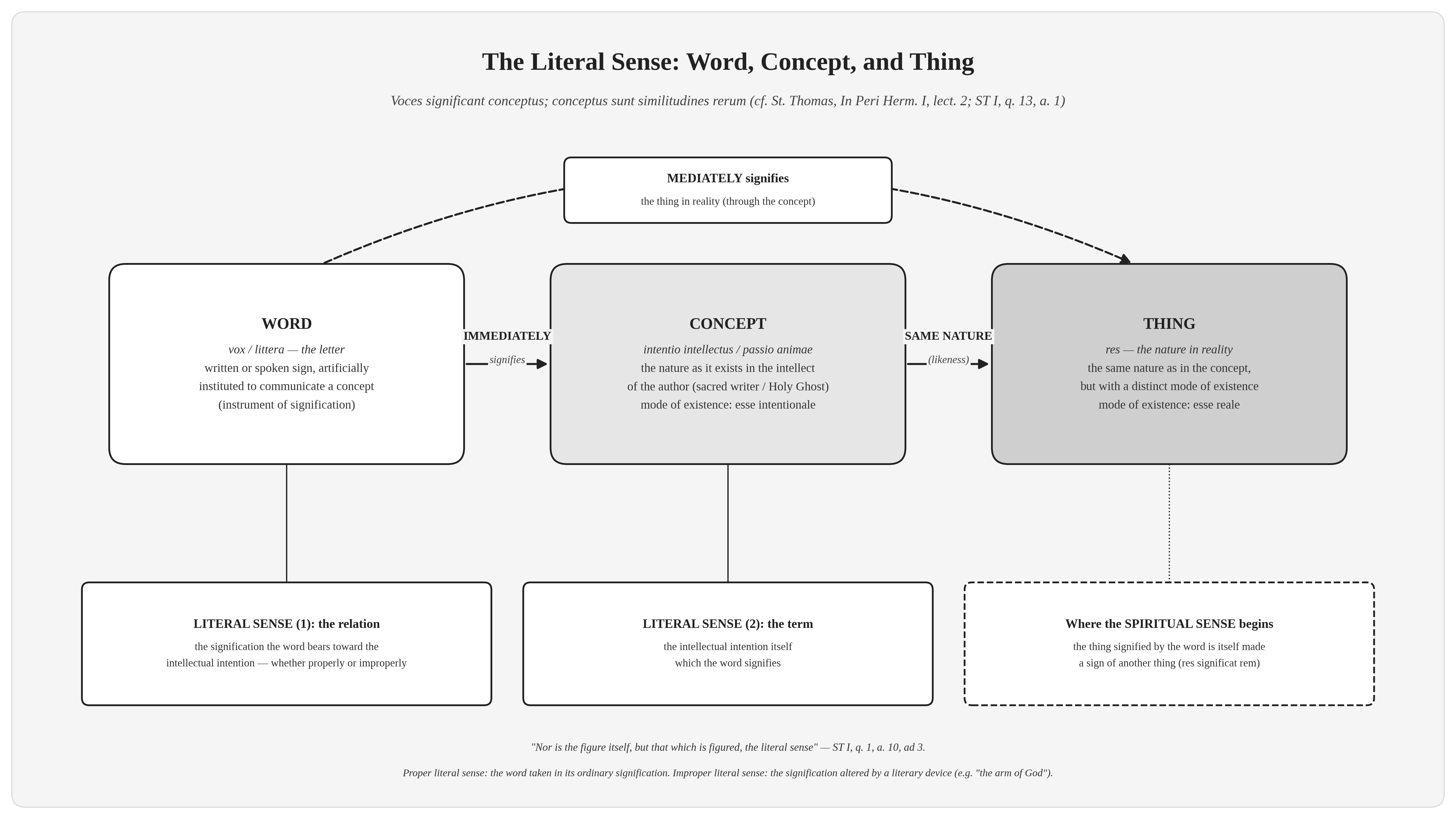
Therefore, for our definition, we can simply describe the literal sense as the “significatory relation of words towards the concept or idea.”
On the spiritual senses. Now that we have the description of the “literal sense” out of the way, we can now move on to determining the “spiritual senses” of Scripture. While the literal sense is the sense of the letter signifying the nature (immediately, as it exists in the intellect; mediately, as it exists in reality), the spiritual sense is the sense of the reality insofar as it signifies some other reality. In order for there to be a sense, there needs to be a sign, a signification, and a reality. The sign is the thing which signifies; the signification is the order of sign to thing signified; the thing signified is the reality to which the sign is ordered. In the case of the spiritual sense, the thing which signifies is the reality itself that the letter speaks of, rather than the words that are the conventional signs; the signification is the intention of God to order these realities to other realities of which they are signs; the thing signified is the reality which the first reality is meant to be a sign of.
It is to be noted carefully what the sign is in the spiritual order. St. Thomas says that “the things signified by the words can themselves be signs of other things.”4 The things in question are the concrete things, persons, and events of which the letter speaks: this gate of the sanctuary which the prophet saw, this ark which David carried into Jerusalem, this priest Melchisedech who met Abraham. It is not the nature of a gate in the abstract that signifies the Blessed Virgin, for then every gate in the world would be a figure of Our Lady. It is the gate of Ezekiel’s vision, that particular thing with its particular history, which God has ordered to signify her.
Let’s take the example of the “gate” which is taken by Fathers and Theologians to be the Blessed Virgin. In the case of the literal sense, the word “gate” is the sign, the signification is the convention whereby we name gates with the term “gate,” and the thing signified is the gate of the sanctuary of which the prophet speaks, conceived by the intellect. In the case of the spiritual sense, rather than starting with the word, we begin with the reality. Therefore, the sign is that gate itself, the signification is the connection willed by God between that gate and the Blessed Virgin, and the thing signified is the Blessed Virgin.
Hence, we can compare the order of signification between the two senses like this:
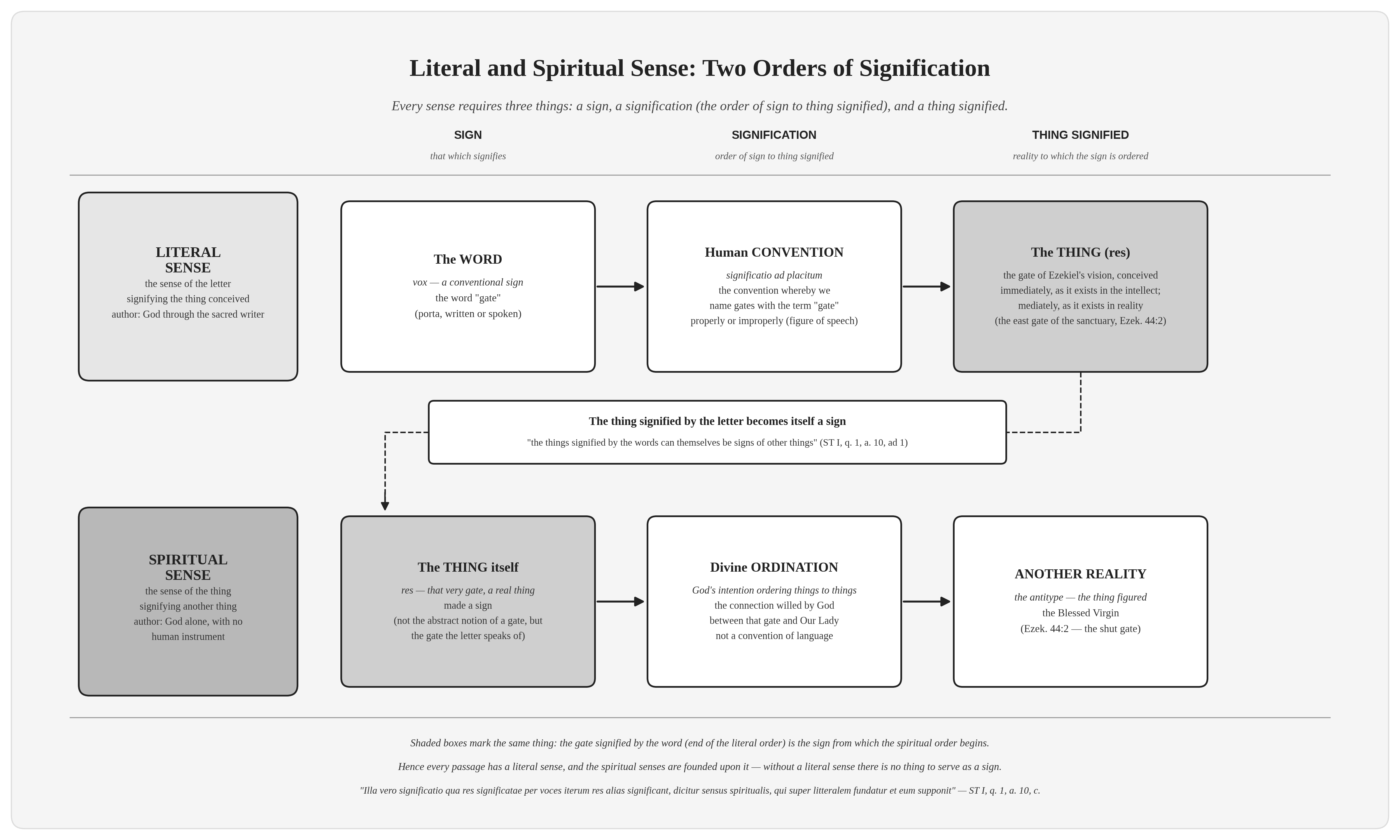
On the connection between the two senses. Here, theologians draw the consequence that the spiritual senses are “based on the literal sense.” We can easily see this by considering the chart used to compare the two senses above. The thing that is signified by the literal sense becomes the sign in the order of the spiritual sense. Therefore, in order to even have the spiritual senses, we need to begin by deriving the literal sense of the passage. I cannot understand that the Blessed Virgin is the thing signified by the “gate” of Ezekiel unless I am able to understand what the term “gate” signifies in the first place. Therefore, in the chart, “the thing signified by the letter becomes itself a sign” connects the “thing signified” in the order of the literal sense to the “sign” in the order of the spiritual sense.
As a corollary, it is to be noted that every passage has a literal sense. This is common among both the Fathers and Theologians. It is common for many to misunderstand the spiritual senses of Scripture as if some passages are to be interpreted as to the literal sense and other passages are to be interpreted as to some spiritual sense. Yet, this is a false understanding that has led to many errors among contemporaries. Every passage has a literal sense (otherwise, the words would be empty), and this literal sense is true (whether taken properly or improperly depending on the context). It is misguided to speak as if some passages had a literal sense and others a spiritual sense insofar as the literal sense is said to be the foundation or basis for the spiritual senses. Since the spiritual senses consider the significatory value of the realities which are signified by the letter, it would be impossible to speak of spiritual senses if there were not a literal sense underlying the spiritual senses.
Although, the diversity of speaking can often obscure this truth. Let’s say we were to consider the conquest of Canaan. Some say that this conquest is not to be taken “literally.” This can be taken in two ways, one committing an error of doctrine and the other committing an error of fact.
The first sense in which this can be taken is to say that the literal sense of the passage is that the Israelites conquered a certain land and that this conquest is false, never having occurred in reality, arguing that we ought merely to take what is signified by the words (i.e., the conquest which never happened) and interpret this spiritually (e.g., the conquest of sin in the life of the believer), holding that what is signified by the letter is false, yet what is signified by the false reality is true. This is a doctrinal error insofar as it denies the dogma of inerrancy.
The second sense in which this can be taken is to say that the literal sense of this passage (due to some literary form) is something besides a certain conquest of a land occurring in reality. These exegetes would argue that the intention was never false insofar as the intention was never to write a historical account of a certain conquest. They would hold that what is signified by the letter (taken in its literary form) is not false, but that the letter was intended to signify some spiritual reality (such as, e.g., a parable would be primarily intended to communicate some spiritual reality). Directly, this commits no doctrinal error, but only an error of fact insofar as it can be scientifically established that the intention of the sacred writer was to communicate something that did historically occur in reality. Yet, indirectly, this error has doctrinal implications insofar as the exegetes who interpret this passage contradict the decree of Trent and Vatican I (which is formally disciplinary, yet fundamentally doctrinal) and the teaching of various Popes of the last century (for more about this particular question, cf. my video on the topic here).
Why do we have the spiritual senses? Here, we are able to consider another angle that clearly shows exactly why theologians formed the common axiom. This is also a point that quite a few moderns have not adequately understood.
Many believe that the spiritual senses cannot be used as the foundation for an argument because these senses are human (an “application”) and not intended by God. This cannot possibly be further from the truth. According to the common teaching of theologians, the spiritual senses are true senses. They are truly intended by the Holy Spirit as much as the literal sense is. Catholic theologians affirm that in the same act that the Holy Spirit willed to express x reality by a certain sign, so also did the Holy Spirit will that x reality itself be a sign for another reality. Ven. Pius XII teaches the same: “For the things which were said or done in the Old Testament were so wisely ordered and disposed by God that past things prefigured in a spiritual manner those things which were to come in the new covenant of grace”; and he commands that “this spiritual sense, intended and ordered by God himself,” be set forth by Catholic exegetes with the diligence the dignity of the matter demands.5
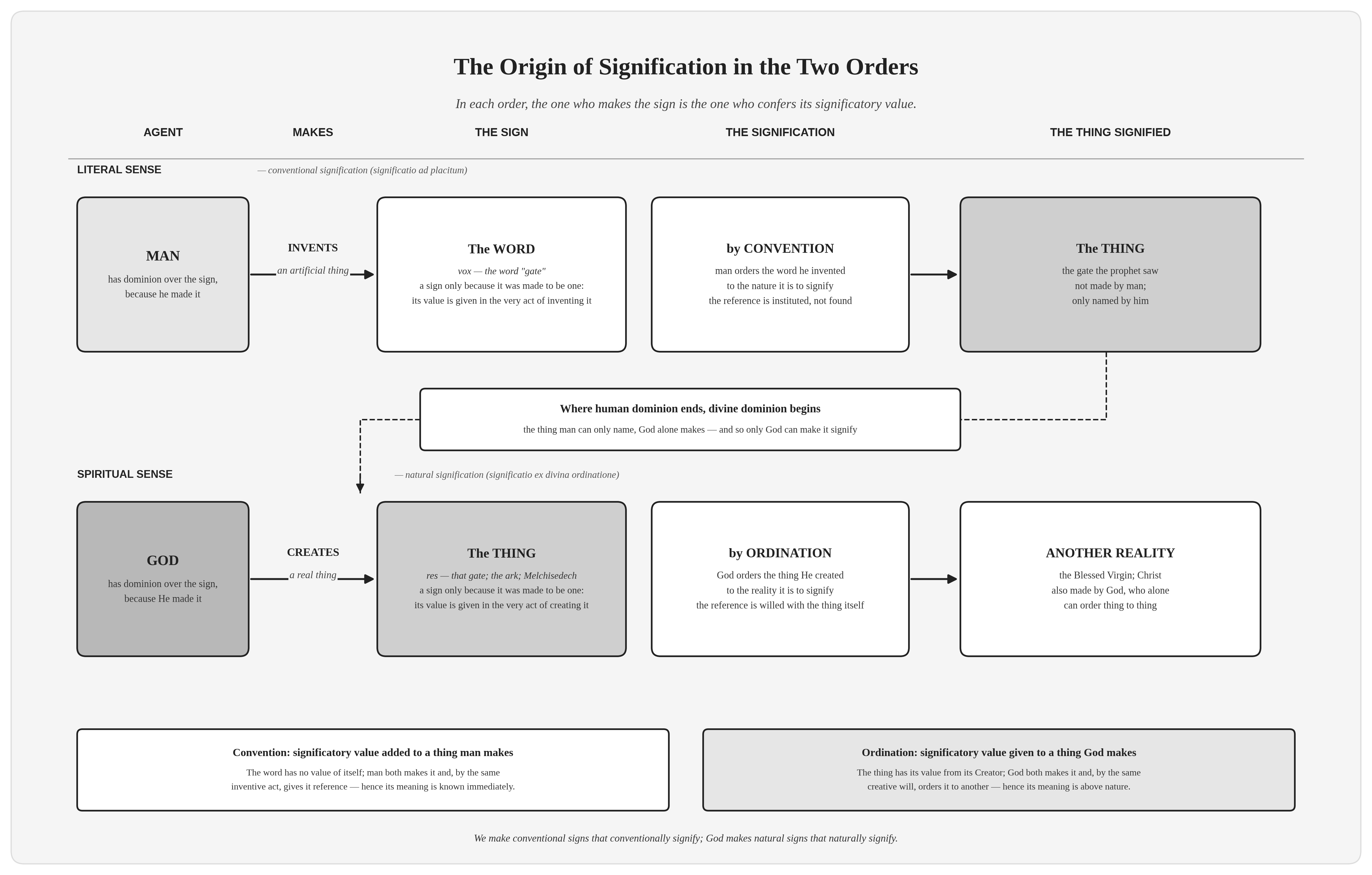
The difference between the two orders concerns the origin of signification. Our words are signs by convention. We invent words that are able to be signs of natures. Conventional signification implies some sort of dominion over the sign since conventionality requires a “creative” act. The inventor of words creates the words and establishes their significatory value towards the thing signified.
This is the exact basis for the distinction between the two orders and will resolve the difficulty quite easily. We can create words, we do not create natures. Natures are created by God and by God alone. We can invent the significatory value of words, but we cannot imbue realities with a significatory value that orders them to other realities, but only by way of “appropriation” (e.g., we appropriate a black cat as a bad omen). Therefore, the case of God and creatures towards signification is radically different. We make conventional signs that conventionally signify, God makes natural signs that naturally signify. Therefore, properly speaking, only Scripture has spiritual senses; human compositions do not, properly speaking, have spiritual senses. This is the express teaching of St. Thomas:
The spiritual sense of Sacred Scripture is taken from this, that things running their course signify something else, which is grasped through the spiritual sense. But things are so ordered in their course that such a sense can be taken from them by him alone who governs things by his providence, who is God alone. (Quodlibet VII, q. 6, a. 3)
John of St. Thomas draws out the reason. Men too use things to signify, as a branch before the door signifies wine for sale; but to designate things to signify in the mystical manner belongs only to him whose it is to order things to a supernatural end, “because he alone can hand down certain and determinate signs with respect to such an end, as is clear from the fact that only God, or one by his authority, can institute the Sacraments, which are signs of grace.”6 Here is a chart comparing the two:
It is to this doctrine that we draw the corollary concerning the demonstrative character of the spiritual senses. The reason why the spiritual senses cannot be used demonstratively isn’t a judgement on the reality of the spiritual senses (they exist as intended by the Holy Spirit). The reason why the spiritual senses cannot be used demonstratively concerns the knowability of the spiritual senses. When we consider the literal sense, we have access to the signification of the signs presented before us since they are established by human convention. Therefore, of itself, the literal sense can be made certain. Yet, the same cannot be said of the spiritual senses.
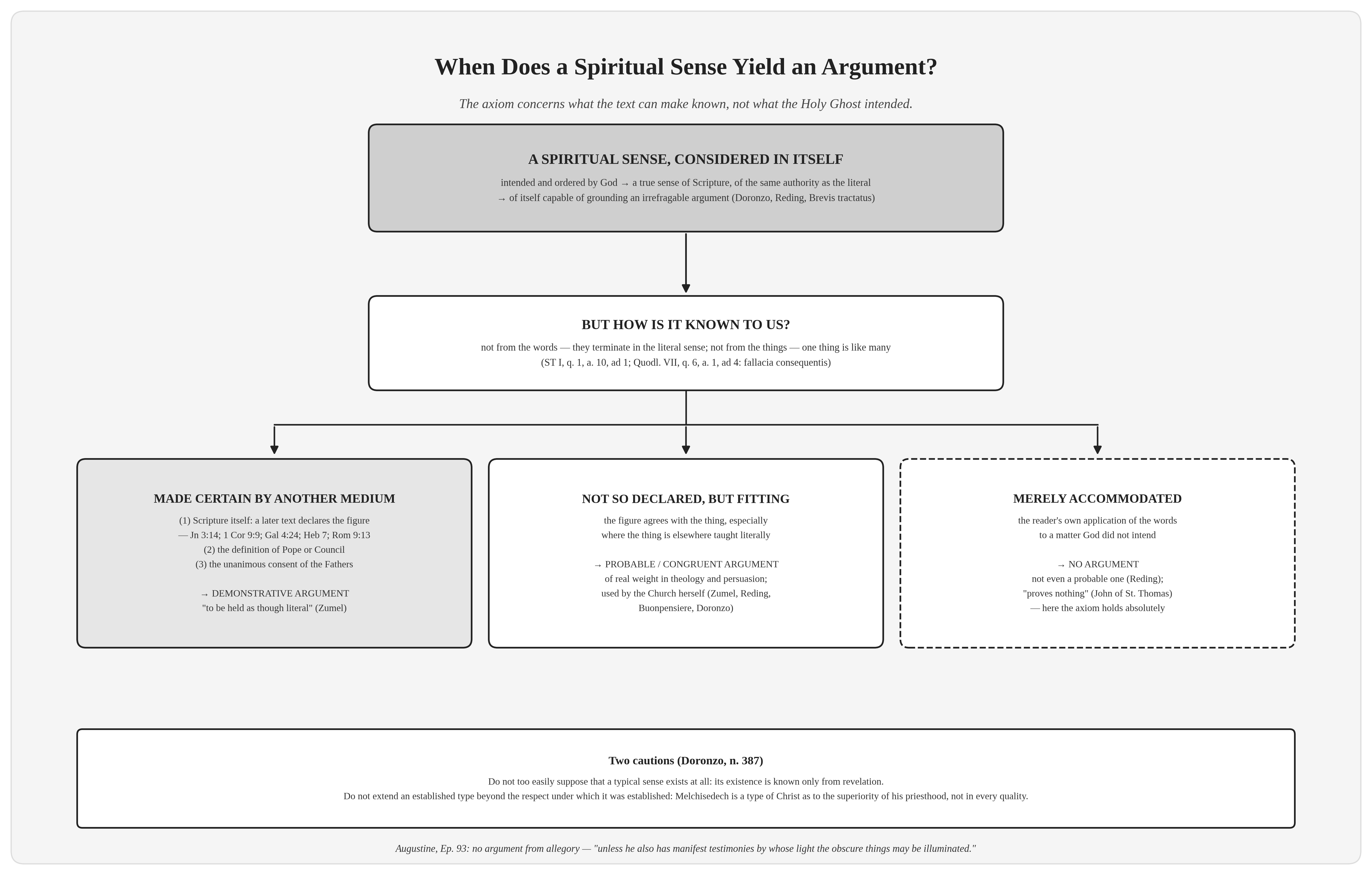
The spiritual senses concern a free act of God above nature, constituting such-and-such a thing to have significatory value towards another reality. This is neither gathered from the words of Scripture, nor from the things. It is not gathered from the words since the words terminate their signification in the reality signified by the literal sense. It is not gathered from the things since this is a free act of God that is above the nature. Now, that which is freely willed by God above the natural order is only known through Divine Revelation. Yet, the spiritual sense goes beyond the literal sense of the passage insofar as it terminates beyond what the letter signified; therefore it follows that the spiritual senses are not made certain by the text which contains them.
This is precisely the reason St. Thomas himself gives when treating this question. In the seventh Quodlibet he is asked whether the fact that no efficacious argument can be drawn from the spiritual sense does not show that this sense has less authority. He answers:
It is not on account of a defect of authority that an efficacious argument cannot be drawn from the spiritual sense, but from the very nature of the likeness on which the spiritual sense is founded. For one thing can be like many things; whence, from that thing, when it is set forth in Sacred Scripture, one cannot proceed to any one of those things determinately, but there is a fallacy of the consequent. For example, the lion on account of some likeness signifies Christ and the devil; whence from the fact that something is said of a lion in Sacred Scripture, no process of argument can be made in Sacred Scripture to either of them. (St. Thomas, Quodlibet VII, q. 6, a. 1)
The reason, then, is not the authority of the sense but the indeterminacy of the sign which can signify a multiplicity of things. The nature upon which God builds the spiritual sense is determined by him to signify a number of different things, and the text does not tell us which of the many he intends. Sylvius states this quite clearly:
[The reason] is not that one sense is of greater authority than the other, but because for the most part it is more easily and more certainly established to us which sense is the literal than which is the mystical. For the literal is sometimes known from the words alone and from the native signification of the vocables, sometimes from the collation of other Scriptures and from the doctrine of the Church; but the mystical cannot be known from the words and the signification of the words, but only from other Scriptures and from the doctrine of the Fathers and of the Church, for it is not signified immediately through the words but through the things signified by the words. (Commentarii in Primam Partem, q. 1, a. 10)
How does this not necessarily lead us to conclude that the Protestant contention against various Catholic theologians is true? In order to understand this, it is important to make two notes.
What was demonstrated in the above demonstration was that the text in which the literal sense is expressed cannot make certain the spiritual sense which the reality signified in the text itself signifies. Yet, if you keep in mind that the spiritual sense is truly intended by the Holy Spirit, this does not mean that demonstration cannot occur either through a different medium or in a different mode.
First note. In a different medium, because the connection between the thing signified by the word and the reality which it itself signifies can be made clear by some other authority. For example, let’s say we considered the text of the ark and its relationship to the Assumption. The literal sense of the text itself does not allow us to certainly conclude that the reality of the ark has a signification towards Mary in the text. Yet, this does not mean that there could not be some other medium which does make this connection. This follows from the fact that the spiritual senses are real senses intended by the Holy Spirit. Therefore, the connection is something that can be revealed to us as any other free act of God above nature and within the extensive object our intellect can be revealed to us.
Like any other revelation, we would fall back on the tract de locis in order to determine how exactly we determine and judge whether something is revealed. The Protestant critique is correct if we were to take that such a connection was made certain by the text itself, but if we were to make the connection by some other means (e.g., another text of Scripture), then the same critique would be fallacious.
It is for this reason that the very Fathers and Theologians who quote this axiom in other parts of their works use the spiritual senses of Scripture to establish matters of faith. Often, this is in the context of gathering the spiritual senses of various prophetic texts whose signification has been made clear by their fulfillment in the New Testament. Our Lord himself and the Apostles do this quite frequently against those who do not accept their authority.
You may object that Our Lord and the Apostles were Divine Legates, therefore they had the authority to declare these matters by an act of Divine Revelation.
To this, the qualification “against those who do not accept their authority” is to be carefully considered. Our Lord and the Apostles would argue fallaciously against those opponents who did not accept their authority if no certain argument under any circumstance could ever be drawn from one of the spiritual senses. Yet, we see them freely drawing from such senses where the signification had been made clear. Therefore, the axiom that “no certain argument can be drawn from the spiritual senses” concerns the spiritual senses and the text considered in itself, not the cases in which the spiritual sense had been made certain through some other means.
Second note. In a different mode, because not all arguments are meant to draw the conclusion in a certain or necessary way, but may be a dialectical argument that draws the conclusion in a probable manner. Now, while the text does not indicate the spiritual sense in the letter so as to certify the precise spiritual sense intended by the Holy Spirit, the same cannot be said for certain probable arguments that are drawn in order to confirm a doctrine or theological opinion.
The Accommodated and Consequent Sense
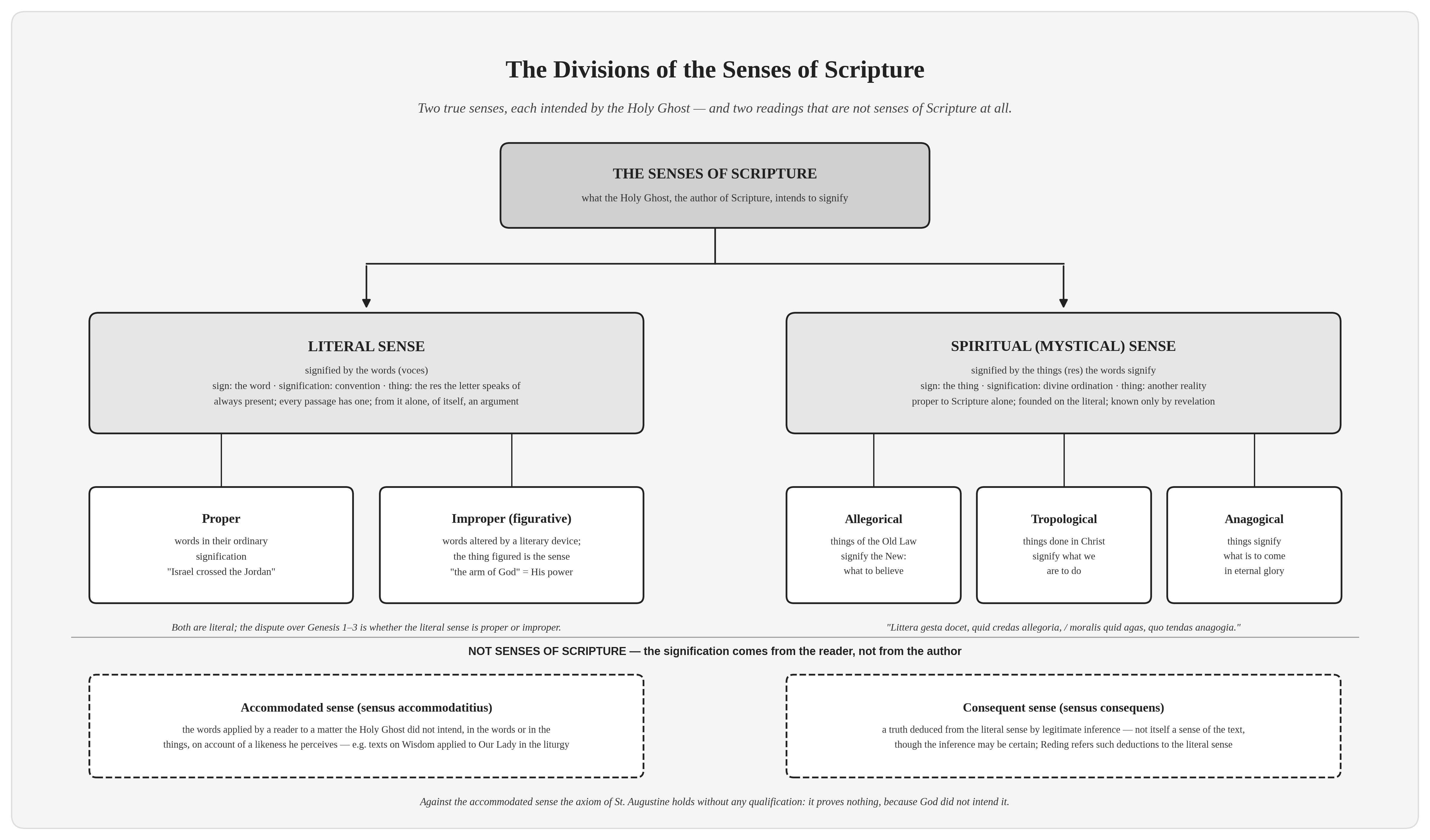
Here, it is important to disambiguate the spiritual sense from two other “senses” of Scripture: the accommodated and consequent sense. Among moderns, a great deal of confusion has arisen over not distinguishing these “senses” properly.
First, the accommodated sense is the human application or appropriation of scripture towards some fitting object. This is frequently done in liturgical documents, especially about the lives of the saints (e.g., when certain texts of scripture are applied to confessors, doctors, virgins, etc., in the liturgy). The accommodated sense arises when a reader applies the words of Scripture to some matter that the Holy Spirit did not intend, either in the words or in the things, on account of some likeness that the reader himself perceives. Such applications may be pious and fitting, but they are not senses of Scripture at all, because the signification comes from the one applying the text and not from the author of the text.
There is no (direct) demonstrative value to the accommodated sense since it is not a sense intended by the Holy Spirit, but by man. As John of St. Thomas teaches: “The accommodated sense is not properly an expository sense, but by an allusion of one thing to another it applies to one what is said of another through some likeness, which is done according to the judgment of the speaker and not according to the sense set down and intended by the author of Scripture, whether in the words or in the things.” And therefore, he says, it “neither explains nor proves anything from Scripture, nor confirms a truth, but only makes an allusion of one thing to another.”7 The Benedictines of Salzburg go so far as to say that it does not yield even a probable theological argument, since it rests on a merely human judgment and the sacred words concur only materially.8 Ven. Pius XII warns exegetes in the same sense: “Let them religiously beware of setting forth other transferred significations of things as though they were the genuine sense of Sacred Scripture.”9
In many cases, when the Protestant says that the Catholic is arguing from a sense he has invented, he is describing the accommodated sense, and against that the axiom of Augustine holds without any qualification whatsoever. But the spiritual sense, as the theologians define it, is by definition intended by God; and so the axiom’s application to it must be qualified, as we have seen.
Second, theologians will also speak of the “consequent sense.” The “consequent sense” concerns those immediate conclusions that are drawn from Sacred Scripture. These only have value as theological conclusions, as I have extensively argued here.
The following chart lays out the whole division:
How the Theologians Have Answered
In the introduction to this article, I said that the theologians universally accept the axiom in a qualified sense. It remains to show this.
The axiom is affirmed without exception. No Catholic theologian I have found denies that, of the spiritual sense considered in itself and taken from the text alone, no efficacious argument can be drawn. Bañez, whom the later authors cite as the classic treatment, puts it as his first conclusion. Zumel sets out the same authorities and adds St. Jerome, who, reporting those who saw the Trinity in the three measures of meal, said: “A pious sense indeed, but never can a parable and the doubtful understanding of enigmas profit unto the authority of dogmas.”10 Suárez: the spiritual sense “is more obscure, and of itself does not avail for the confirmation of dogmas, unless it be authentically explained elsewhere, according to St. Thomas, I, q. 1, a. 10.”11 This is also commonly taught by Medieval theologians, who I hardly need to cite.
The reason is the knowability of the sense, not its authority. We have already heard St. Thomas and Sylvius on this. The Dominican Berthier states this quite clearly: the mystical sense “does not prove immediately and of itself. The reason is that it does not exist necessarily, but hypothetically, that is, from the free will of God; nor is it expressed by natural signs but by arbitrary ones, whose force of signifying no one can perceive unless the will of him who at his pleasure gave the signification becomes known to him from elsewhere.”12 Doronzo, in the last of the great manuals, gives the same account: the literal sense is “more manifest and more certain, since it does not require a revelation, as the typical sense does, in order to be known with certainty; and therefore, consequently, it is scientifically more efficacious and so more apt for theological argumentation.”13
Where the spiritual sense is made certain by another means, it yields a demonstrative argument. This is the key qualification given by the theologians, which I showed from the nature of the case above. Zumel gives it as his second conclusion:
When the Holy Spirit, either through the Apostles, or through the Prophets, or through the other sacred writers, has explained to us some place of Sacred Scripture in the spiritual sense, then from such a testimony and from such a sense of Scripture an efficacious argument may be taken for faith and morals; indeed, that spiritual place would have to be held by us as though it were literal. The reason for this conclusion is that such a sense would be intended by the Holy Spirit; and further, because that sense is now contained in Sacred Scripture, and Sacred Scripture is efficacious for proving the faith. And so that rule, “the mystical sense is not to be admitted as efficacious for the proof of any dogma,” is not always and everywhere to be observed. For if it is established from other places of Scripture that that mystical interpretation is intended by the Holy Spirit, or is according to the genuine and true sense of the passage, then indeed from such a mystical sense an argument can be drawn for establishing some doctrine. Whence Paul, in 1 Corinthians 9, from the text “Thou shalt not muzzle the mouth of the ox that treadeth out the corn,” proves that we are bound to support the ministers of the Church. St. Augustine plainly indicates this in the words just cited. For after he had said that it was impudence to adduce in one’s own favor something set down in allegory, he immediately excepts a special case from this general sentence, saying: “unless he also has manifest testimonies, by whose light the obscure things may be illuminated.” Therefore, when it can be established that such a mystical sense is the true sense of that letter, an argument is very well deduced from it. (ibid., concl. 2.)
Notice that Zumel finds the qualification in Augustine’s own sentence. The “unless” clause of the letter to Vincent is exactly what the Theologians develop this qualification from (for, if the argument holds good for one theological locus, i.e., the explicit testimony of a text of scripture, then it holds good for the other theological loci as well).
Sylvius makes the same point: “But where it has been established concerning the mystical sense of some Scripture, whether through another place of Scripture, or through the unanimous consent of the Fathers, or through the doctrine of the Church, then a firm argument can be drawn from that sense, since the mystical sense is also a true sense of Sacred Scripture, and intended by the Holy Spirit, and consequently of the same authority and certainty as the literal.” Reding makes it his third conclusion: “The mystical sense, if it be established that it is intended by the Holy Spirit, furnishes a firm theological argument; but because it is for the most part unknown from infallible authority, it can more rarely be suitable for demonstrative theological argumentation.”14 The anonymous Brevis tractatus de locis theologicis explains the same:
From the spiritual sense considered in itself an irrefragable argument can be deduced; but since we sometimes know only probably that a spiritual sense is contained in some text of Scripture, therefore from it we then draw only probable arguments; but if it is certainly established to us, from it we can argue efficaciously. And indeed Christ himself and the Apostles argued most efficaciously from it: Christ (John 3), from the lifting up of the brazen serpent in the desert, efficaciously proves his own lifting up on the cross, spiritually figured in that serpent; and Paul (1 Cor. 9), from the text ‘Thou shalt not muzzle the mouth of the ox that treadeth out the corn,’ proves that stipends are owed to the ministers of the Gospel.
Pesch warns that a false conclusion must not be drawn from the words commonly used by theologians:
[What Ss. Thomas and Augustine intend] is this: that it is not lawful to gather from the figures whatever possible likenesses one pleases and to argue from them. But it is another thing if Sacred Scripture teaches that some thing is a figure of another thing under this or that aspect… For as soon as it is certainly established that a past thing by divine institution figures a future thing under this or that respect, without doubt one may argue with absolute certainty that the thing and the aspect figured by the type are necessarily found in the antitype. (De inspiratione Sacrae Scripturae, n. 176)
And Doronzo:
From the same reason of its divine origin it follows that this sense has probative force, and that of itself apodictic, provided that its existence be certainly demonstrated, which cannot be done otherwise than from the revelation of God himself; thus, from the fact that, as the Apostle testifies, Melchisedech in his priesthood is certainly a type of Christ, it can be apodictically inferred that Christ, no less than Melchisedech, offered a sacrifice. (loc. cit., n. 386)
The means by which a spiritual sense is made certain are three. The authors are again unanimous in enumerating them. First, Scripture itself, when a later text declares the sense of an earlier one, as the New Testament declares the figures of the Old. Second, the definition of the Church, whether by a Pope or a Council. Third, the unanimous consent of the Fathers. The anonymous Thomist just quoted lists them in this order and calls the unanimous understanding of the Fathers “a firm argument.” Reding gives the same three, with the example of Romans 9 declaring Jacob and Esau to be figures of the Gentile and Jewish peoples, and the common consent of the Fathers establishing that the Synagogue was a type of the Church and Solomon of Christ. Buonpensiere, commenting on St. Thomas in the last century, lays down the rule in the same terms: that sense “is to be retained as certainly intended by the Holy Spirit which is declared in express words either in another place of Sacred Scripture, or by the definition of a Pope or Ecumenical Council, or by the unanimous consent of the Fathers”, and where a sense is not so supported it “remains within the bounds of probability.”15
What remains is a probable argument. This is the second note that I gave above and applies to those places where the sense is not certainly established. Zumel argues that, in such a case, the spiritual sense “is not superfluous, for it profits to persuade and to draw men to the good.” He goes further, and notes the practice of the Church:
We see that the Church and the holy Pontiffs, when they often prove matters of faith, use testimonies of Sacred Scripture in the spiritual sense, when the figure fits very well with the thing proposed and to be proved. For a figure well placed and explained has much strength in disputation, especially when the thing itself is established from other places of Scripture in the literal sense; therefore, when the thing figured has somewhere in Sacred Scripture a literal sense, the argument from the figure is an excellent one. (loc. cit.)
Reding classes such arguments, “resting at least probably on divine revelation,” as belonging to theology, “whether scientific or at least opinative.”16 Doronzo adds two cautions: not to suppose too easily that a typical sense exists at all, and not to extend an established type beyond the respect under which it was established. It is because of such uncertainties, he says, that St. Thomas “seems, to the surprise of some, to deny it all efficacy,” and that the modern theologian ought to use the argument from the typical sense “sparingly and safely.”17
The whole matter can be gathered into one chart:
Conclusion
From the spiritual sense of a text, considered in itself and gathered from that text alone, no demonstrative argument can be drawn, because the spiritual sense is a free ordination of God above the nature of things, which the text does not declare and which the likeness of the things does not determine. This is the common testimony of the Fathers and Theologians.
Yet, we ought to be careful not to transfer an axiom about the knowability of the Holy Spirit’s intention in a text to a denial of the Holy Spirit’s intention in a text. The spiritual sense is a true sense, intended by God as much as the literal, and where God has made his intention known by some other means (by another text of Scripture, the judgment of his Church, the unanimous voice of the Fathers, etc.) the argument from the figure is as firm as any argument from the literal sense. Where the intention is not certain, the argument from the figure remains a probable argument, of real weight in theology and of great use in persuasion, and the Church herself uses it as such.
Summa theologiae III, q. 28, a. 3, sed contra.
Pius XII, Munificentissimus Deus, n. 26.
Council of Trent, Session XXII, cap. 1
Summa theologiae I, q. 1, a. 10, ad 1
Pius XII, Divino afflante Spiritu, nn. 26–27
John of St. Thomas, Cursus theologicus, In I, q. 1, disp. 2, a. 12, nn. 13–14
loc. cit., n. 17
Reding, Theologia scholastica, t. I, q. 1, a. 4, controv. 4, concl. 4.
Divino afflante Spiritu
St. Jerome, Commentarii in Matthaeum II, on 13:33
Suárez, De fide, disp. 5, sect. 3, n. 12
Berthier, Tractatus de locis theologicis, pars I, lib. I, n. 254
Doronzo, Theologia dogmatica, vol. I, De locis theologicis, n. 386
loc. cit.
Buonpensiere, Commentaria in Primam Partem, q. 1, a. 10, nn. 133–134
loc. cit., concl. 4, n. 25.
loc. cit., n. 387.