
In Exodus 19-24, there is the culmination of the entire book. Israel had departed from Egypt, defeated the Amalekites, and now they are at Mount Sinai. God descends upon the mountain and the people are ordered to keep their distance lest they die. There is the ratification of the covenant done by a covenant meal and Moses, as appointed legate of God to Israel, hears the commands of God.
From Exodus 25-31, Moses receives a revelation from God about specifically liturgical instructions for the making of a certain tabernacle which will be a permanent presence of God among his people. It is at this point that many “bible in a year” reading plans are destroyed. It goes into various different obscure and (seemingly) useless details about the manner in which Israel is to worship God.
PLEASE CONSIDER SUBSCRIBING FOR MORE ARTICLES!
Yet, an awareness of the details of Israelite worship in the Tabernacle actually reveals many clear things about the entire economy of salvation which will be fulfilled and brought to completion in Christ, as St. Paul makes clear in Hebrews. One of the clearest of these is the presence of two altars in the tabernacle, which many do not play close enough attention to.
When we think of the sacrifices made in the tabernacle, most of us think about the sacrifices that take place in the outer court of the temple. There is an altar there upon which bloody (and even non-bloody) sacrifices take place.
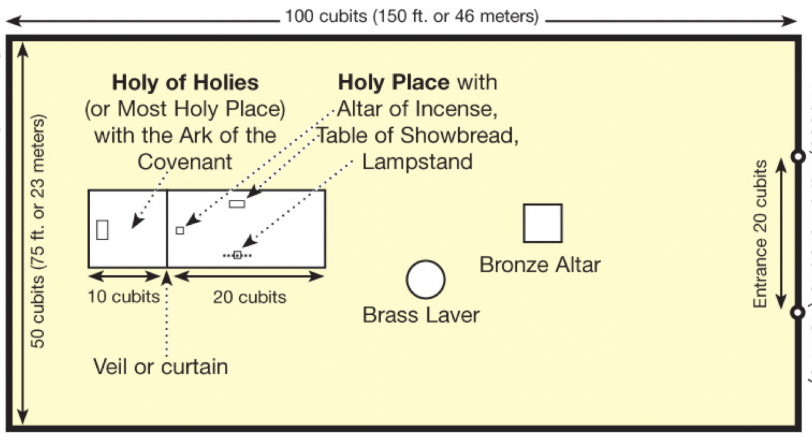
In the above illustration, this place is outside the “holy place” and the “holy of holies.” It contains that bronze altar which is called the “altar of burnt offerings.” Under this altar, the fire continually burned (Lev. 6:13) and various different sacrifices were made,
Now this is what you shall offer upon the altar: two lambs a year old day by day continually. One lamb you shall offer in the morning, and the other lamb you shall offer in the evening; and with the first lamb a tenth measure of fine flour mingled with a fourth of a hin of beaten oil, and a fourth of a hin of wine for a libation. And the other lamb you shall offer in the evening, and shall offer with it a cereal offering and its libation, as in the morning, for a pleasing odor, an offering by fire to the Lord. It shall be a continual burnt offering throughout your generations at the door of the tent of meeting before the Lord, where I will meet with you, to speak there to you.
This is outside the “tent of meeting” where there is the presence of the Lord, exemplified especially in the holy of holies by the ark of the covenant. It was here especially that sin was expiated, which will become even more evident when we look at the ritual for the day of atonement and the explanation of the redemption of Christ by St. Paul in Hebrews.
Hence, e.g., during the ordination of priests, this is where the bull and rams were sacrificed (cf., Ex. 29:10-37). In this, it is also important to note that there are distinct acts of “offering for atonement” and the “anoint to consecrate.” (v. 36) This also becomes important when we consider the ritual for the day of atonement and the relationship between the altars. Yet, this is not only the case with the ordination of priests, but also the sin (and other) offerings present in the day to day life of the Israelites (cf., Lev. 1-7).
Yet, there is also a second altar. This altar isn’t an offering of burnt offerings, bloody sacrifices, etc., it is an “altar of incense.” As you can see in in above diagram, this altar was not outside the tent, but within the tent. Along with this altar, there was the table of showbread (which represented the presence of God and was eaten by the priests weekly) and the lampstand. This section was separated by a veil. The same veil is present in the temple as well, and was torn at the death of Our Lord.
This is described thus,
Aaron shall burn fragrant incense on it; every morning when he dresses the lamps he shall burn it, and when Aaron sets up the lamps in the evening, he shall burn it, a perpetual incense before the Lord throughout your generations. You shall offer no unholy incense thereon, nor burnt offering, nor cereal offering; and you shall pour no libation thereon. (Ex. 30:7-9)
The only “blood” that was present on this altar was the blood that was needed to atone for the altar. There was not the need of purification. This was to happen once a year,
Aaron shall make atonement upon its horns once a year; with the blood of the sin offering of atonement he shall make atonement for it once in the year throughout your generations; it is most holy to the Lord. (v. 10)
We will get more into this later when we discuss a passage from Leviticus and St. Paul’s explanation in Hebrews. The third “altar” is not really an altar at all since there was not really, properly speaking, any sacrifice done on it. It is the ark of the covenant. As you can see above, beyond the veil there was an ark that represented the very throne of God. It was there that the high priest was to meet God in the ritual of the day of atonement.
This ritual is described in Leviticus 16. First, Aaron is told that his entrance into the holy of holies before the ark was not supposed to happen all the time, but only at the appointed time, lest he die:
Tell Aaron your brother not to come at all times into the holy place within the veil, before the mercy seat which is upon the ark, lest he die; for I will appear in the cloud upon the mercy seat. (Lev. 16:2)
The ritual begins by various different sin offerings, especially unique is the “scape goat,” which is sent into the wilderness. After this point, we have the combination of the two altars in entering into the presence of God. Aaron (after making atonement for himself and the people), was to take incense from the altar of incense and enter into the holy of holies:
He shall take a censer full of coals of fire from the altar before the Lord, and two handfuls of sweet incense beaten small; and he shall bring it within the veil and put the incense on the fire before the Lord, that the cloud of the incense may cover the mercy seat which is upon the testimony, lest he die; and he shall take some of the blood of the bull, and sprinkle it with his finger on the front of the mercy seat, and before the mercy seat he shall sprinkle the blood with his finger seven times. (v. 12-14)
The is basically the gist of the ritual. Sacrifice is made on the first altar. Incense is taken from the second altar. Entrance is made into the holy of holies with a cloud of incense and the sprinkling of blood. Yet, how are these two altars significant?
In redemptive history, there are two points which are quite interesting.
First, we have the prophecy of Malachi. In the beginning of the prophecy, the Lord complains of the irreverence with which the various different food offerings had been made to him. He rejects them due to their lack of purity. Then, rather than stating an absolute end to sacrifice, he states
For from the rising of the sun to its setting my name is great among the nations, and in every place incense is offered to my name, and a pure offering; for my name is great among the nations, says the Lord of hosts. (Mal. 1:11)
A few important things to note here. First, the offering is not the offering of the first altar (which he stated that he rejects due to its defects), but the offering of the second altar (which he states is a pure offering). Second, this is not said to take place at the temple, but “in every place.” Hence, this prophecies a time in the future where such offering will take place beyond the confines of Jerusalem.
Second, we have the tearing of the veil in the temple.
Jesus cried again with a loud voice and yielded up his spirit. And behold, the curtain of the temple was torn in two, from top to bottom... (Mt. 27:50-51)
Remember that the curtain was present as a veil that separated the holy place from the holy of holies. That is the significance and if you understand that significance, you are able to understand why it was torn. To give a theological explanation to this, we must take into account the fact that the cross was the altar upon which Christ died outside of the city.
For the bodies of those animals whose blood is brought into the sanctuary by the high priest as a sacrifice for sin are burned outside the camp. So Jesus also suffered outside the gate in order to sanctify the people through his own blood. (Heb. 13:11-12)
In the economy of salvation, Christ is the high priest who suffers on that altar, not for his own sins, but for the sins of those of his people. It is outside the city because the altar of bloody sacrifice was outside of the tent in the outer courts. What, then, is the significance of the ark, the altar of incense, and the curtain?
He begins chapter 9 by outlining what we already know about the general details of the temple,
Even the first covenant had regulations for worship and an earthly sanctuary. For a tent was prepared, the outer one, in which were the lampstand and the table and the bread of the Presence; it is called the Holy Place. Behind the second curtain stood a tent called the Holy of Holies, having the golden altar of incense and the ark of the covenant covered on all sides with gold, which contained a golden urn holding the manna, and Aaron’s rod that budded, and the tables of the covenant; above it were the cherubim of glory overshadowing the mercy seat...These preparations having thus been made, the priests go continually into the outer tent, performing their ritual duties; but into the second only the high priest goes, and he but once a year, and not without taking blood which he offers for himself and for the errors of the people.
Compare this description with the above one and you will be a stark difference.
When treating the outer tent, he indicated the following,
A tent was prepared, the outer one, in which were the lampstand and the table and the bread of the Presence; it is called the Holy Place.
When treating the inner tent, he indicated the following,
Behind the second curtain stood a tent called the Holy of Holies, having the golden altar of incense and the ark of the covenant covered on all sides with gold, which contained a golden urn holding the manna, and Aaron’s rod that budded, and the tables of the covenant; above it were the cherubim of glory overshadowing the mercy seat.
What do you notice? In the original tabernacle, the altar of incense was NOT in the inner tent, it was in the outer tent. It was only during the day of atonement that there is a certain kind of “movement” of the altar of incense into the holy of holies.
This is vital for understanding what St. Paul says next,
By this the Holy Spirit indicates that the way into the sanctuary is not yet opened as long as the outer tent is still standing (which is symbolic for the present age). According to this arrangement, gifts and sacrifices are offered which cannot perfect the conscience of the worshiper, but deal only with food and drink and various ablutions, regulations for the body imposed until the time of reformation.
When we are considering the “passing away” of the tabernacle, what are we considering? We are considering the “fall” of the outer tent since “the way into the sanctuary is not yet opened as long as the outer tent is still standing.” Does the inner tent still stand? Yes. Does the inner tent contain sacrifice? Yes, it contains the sacrifices present upon the altar of incense. The sacrifice that happened “outside of the tent” was sprinkled upon the altar in the ascension of Christ.
By the blood of Christ which was shed on the altar of the cross outside of the city, we have a removal of the veil, i.e., access to the ark of the covenant (to God). This removal of the “outer tent” way of worship leaves those elements of the inner tent standing, which includes those sacrifices that take place on the altar of incense.
It is for this reason that the Apocalypse still presents the altar of incense in the heavenly tabernacle,
Another angel came and stood at the altar with a golden censer; and he was given much incense to mingle with the prayers of all the saints upon the golden altar before the throne; and the smoke of the incense rose with the prayers of the saints from the hand of the angel before God. (Rev. 8:3-4)