
One of the most consequential perennial disputes in theology concerns the dispute over how to remedy a daily occurrence for any Catholic. In the moral life, we often find ourselves at a crossroads; we cannot decide whether engaging in this action is sinful or not. We have tried everything we can in order to resolve the doubt, but we are simply stuck. For many Catholics, one may think that the solution to this problem is easy–if we are unsure whether something is sinful or not, then it is appropriate to do whatever one wants. Yet, this is a laxist doctrine condemned by the Church (Against the New Laxism). Rather, we are obliged to form a morally certain conscience before acting.
You may object that this seems to be contradictory. In this circumstance, the exact problem is that an absolutely certain conscience cannot be formed. For this reason, moralists have developed various principles for resolving the doubtful conscience.
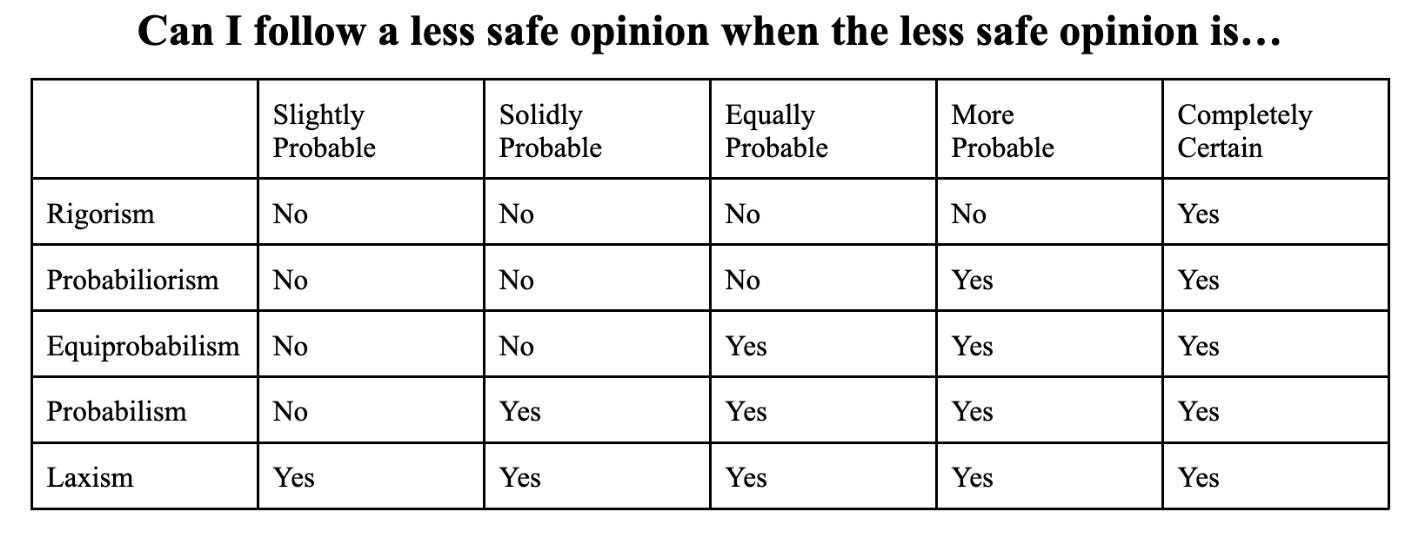
There are two extreme systems that employ principles that the Church has condemned. First, “rigorism” or “tutiorism” teaches that, in order to act safely, we need to be completely certain that the law does not exist, i.e., it leaves no room for the opinionative judgement, preserving fear of the opposite. Second, “laxism” teaches that, in order to act safely, a certain small or doubtful probability about the non-existence of a law is sufficient. For example, the simple fact that a theologian has posited a view is sufficient to act safely.
Between these two extreme systems, there are four systems permitted by the Church.
α) First, probabiliorism denies (against rigorism) that there needs to be a complete certainty about the non-existence of the law in order to act safely; rather, it simply denies that it is permitted to act according to a less probable (or equally probable) opinion when the action is less safe. In this view, we are only able to act according to the less safe side when it is more probable. The foundation for probabiliorism concerns both a direct principle, i.e., that the more probable is morally certain, and an indirect principle, i.e., if a man errs in following the more probable, his ignorance is invincible. NOTE: The probabiliorists argue that the man is morally certain if the act appears to him to be more probable. Hence, it often occurs that what is the less common opinion is more probable as appearing more true on the basis of intrinsic grounds to a man.
β) Second, probabilism invokes the reflex principle that the man who acts probably acts prudently. Further, they invoke the principle that a law must be sufficiently promulgated in order to bind; hence, they reason that, if a law does not certainly bind the conscience, then it does not bind the conscience at all. From this, they conclude that, if a position is solidly probable (even if less probable and less safe), then a man may act freely in such a matter.
γ) Third, equiprobabilism attempts to combine the best of both probabiliorism and probabilism: a) against probabilism, it holds that the less probable and less safe cannot be chosen; b) against probabiliorism, it holds that the equally probable and less safe can be chosen.
δ) The fourth position is compensationism, which is a bit more complicated. This position holds that the amount of probability sufficient is dependent on the gravity of the situation, more needed for more grave situations.
To give a visual of the positions:
What is a Thomist to make of all of this? Personally, since I first read about the debate, I found myself agreeing with the probabilist position. Yet, historically, the many prominent members of the Thomistic school have been probabiliorists (e.g., Gonet, Billuart, Contenson). In this article, I want to set forth some of their arguments for the position.
First Argument. None of the fathers or ancient scholastic theologians held that it is lawful to follow the less safe opinion when it is less probable. Now, if probabilism were true, then the greater part of the Church was imposing an intolerable burden on the consciences of the faithful in their pastoral practice. Therefore, etc.
In response to this, probabilists will usually deny the major premise, arguing that their position is actually the more ancient. In this effort, they will heap up citations from ancients who simply concede that it is lawful to follow a probable opinion. Yet, Cardinal di Lauria (III Sent., tom. ii, disp. xi, art. iv) and many others argue that the word ‘probable’ is misunderstood here, actually referring to the more probable opinion. This error as to the nature of the probable opinion foreshadows the fundamental error of the probabilist position, according to probabiliorists.
Second Argument. The foundational argument of the probabiliorists against the probabilists runs as follows: to act prudently, it is required that one have moral certainty about the lawfulness of the act, excluding all moral fear; now, the one who favors a less probable and less safe opinion against what seems more probable and more safe to him does not have moral certainty about the lawfulness of the act; therefore, etc.
The reason for the major premise concerns the nature of prudence as an intellectual virtue. Since prudence is an intellectual virtue, it requires firm adherence to the truth. Now, such is excluded by a doubtful adherence. Therefore, since both cannot coexist, neither can a morally certain act and a doubtful adherence coexist. This is conceded by all.
Yet, the more pressing matter is the minor premise, which forms the foundation of the dispute. The proof is as follows: if one judges that his action is more probably unlawful, then he does not judge that it is morally certain that his action is lawful; now, one who follows a less safe and less probable opinion judges that it is more probably unlawful; therefore, he does not have moral certainty that his action is lawful.
In response to this argument, they deny the minor premise (”one who favors a less probable and less safe opinion against what seems more probable and more safe to him does not have moral certainty about the lawfulness of the act”). Against the proof of the minor premise, they invoke a distinction between direct and indirect principles. While the probabilists concede that they do not have moral certainty by direct principles (i.e., in considering the intrinsic and extrinsic arguments for the premise), they deny that they do not have moral certainty in virtue of indirect and reflex principles (e.g., “he who acts probably, acts prudently”).
To prove this reflex principle, they argue as follows: whoever follows a prudent dictate of right reason acts prudently; now, whoever follows a probable opinion follows a prudent dictate of right reason; therefore whoever follows a probable opinion acts prudently.
First, in response to this, it is argued by probabiliorists that a morally certain judgement can only be derived from morally certain principles. Now, such a reflex principle is not morally certain (as evidenced from the great dispute over the principle). Therefore, the judgements derived from the principle are not morally certain.
The reason for this is that, as St. Thomas teaches, the premises are as the efficient cause of the conclusion. Now, the effect cannot exceed the perfection of the cause. Hence, the effect of moral certainty cannot be derived from the cause of mere probability.
Second, probabiliorists argue that it is absurd to both hold that an act is certainly morally licit and that it is more probably against the Divine Law. Hence, the appeal to a reflex principle is absurd, as conceding contrary intellectual habits within a man toward the same object.
Objection. In response to this, probabilists argue that the probabiliorists argue in a self-contradictory manner. For, just as the reflex principle of the probabilists is only probable, so also are the direct judgements of the probabiliorists. Hence, they would either slide into rigorism or admit that a probable reflex principle is sufficient in such matters.
The response to this objection is able to truly reach the root of the dispute. The objector errs insofar as he understands “moral certainty” to mean the same degree of certainty as avails in the speculative order. Rather, moral certainty in the principle initially enunciated refers to something that is more probable. Hence, the objection is impotent.
When we speak of “more probable” and “less probable” we speak on behalf of the weight of the arguments and the motives for ascertaining truth. Now, when a man considers both sides of the problem and sees that one has more grave motives for assent, then this absorbs the less grave motives for the opposite side. For, to be drawn to one terminus is to be drawn away from its opposite. Hence, to be “more probable” in the moral sphere is to attain certitude as to the prudence of the act, withdrawing from the opposite as lacking certitude. With this consideration, the entire dispute dissolves. How can a direct principle withdraw the intellect from a certain side of a doubt as dubious while an indirect principle simultaneously draws the intellect toward that same side as certain?
From this, probabiliorists conclude that the “less probable” does not have true probability comparatively as to the more probable in the intellect of the one judging moral truth. Hence, to follow such a position is imprudent.
